

 Español
 Deutsch
The present dispute arises from an application for registration of an EU trade mark for a three-dimensional sign consisting of a hand-shaped corkscrew, for goods in Class 21. That application was rejected on the grounds that the sign applied for consisted exclusively of the shape of the product necessary to achieve a technical result in relation to the goods applied for. The Board of Appeal upheld the decision to refuse registration, finding that the essential characteristics of the sign were dictated by the technical solution achieved.
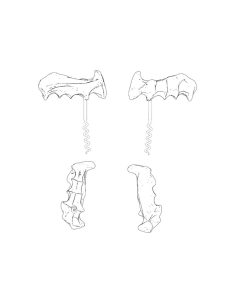
The applicant appealed against the Board of Appeal’s decision arguing that it had not been demonstrated that all the essential features of the sign’s shape were purely functional. However, the Board of Appeal considered that the sign in question (a corkscrew) had an irregular, bone-shaped handle that fits each finger of the hand and an extended shaft, which served the technical function of the product, namely removing the cork from a bottle. Thus, the ergonomic handle, which mimics the anatomy of a hand, was intended to provide a better grip and therefore it was not a purely aesthetic feature.
The applicant argued that the body of the corkscrew was not claimed as part of the sign applied for, and therefore the resulting technical function of extraction cannot be attributed to the sign applied for. However, the General Court considers that EUIPO may analyse the technical function of the essential features by taking into account those additional elements relating to the function of the specific product, even if these are not visible in the representation. Furthermore, the ground for refusal of signs consisting exclusively of the shape of a product, also extends to signs consisting exclusively of the shape of a part of the product necessary to achieve the technical result. In this case, as the product is a corkscrew, the General Court considers that the Board of Appeal did not err in its assessment of the body of the corkscrew, since it is an inherent and indispensable element of the product, which determines the functionality of the contested sign and the identification of its essential characteristics.
As regards the essential characteristics, the applicant considers that these have been incorrectly identified, as they are not exclusively linked to the technical function, and the aesthetic, creative and unique nature of the handle—which reproduces the shape of a human hand—has been overlooked. However, the General Court considers that this element also has an ancillary functional effect, as it allows for a better grip on the tool.
The applicant also refers to the unique and original nature of the corkscrew, as, in its view, it departs from traditional corkscrew designs. However, the General Court considers that it is not relevant to take into account the distinctive character of the elements of a sign when determining the essential characteristics of a shape.
For all these reasons, the action brought by the applicant is dismissed, and the trademark application is rejected due to its functional nature.
Judgment of the General Court (Second Chamber) of 25 February 2026, in Case T-437/25